A new ingredient appears in the EU Union list of authorised novel foods.
Does that mean every supplement brand can immediately source an equivalent ingredient, formulate at the authorised dose and launch it across Europe?
No.
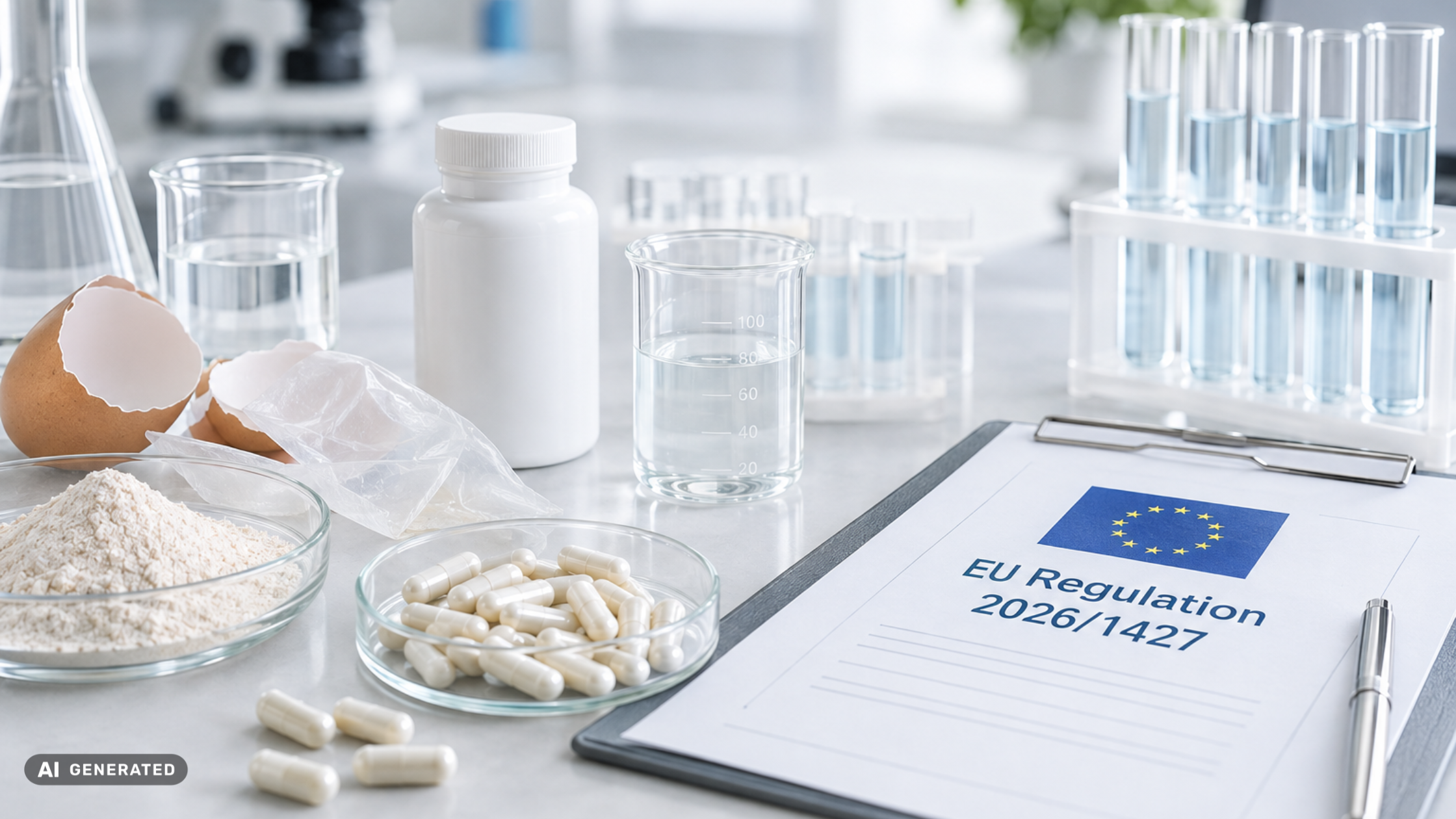
Commission Implementing Regulation (EU) 2026/1427, adopted on 2 July 2026 and applicable from 23 July 2026, authorises a specific enzymatically produced egg membrane hydrolysate for use in food supplements.
The authorised use is limited to 500 mg per day for the general adult population, excluding pregnant and lactating women. The regulation also introduces specific labelling requirements, egg-allergen obligations and a five-year period of protected proprietary data.
For supplement brands, the practical lesson is important:
Novel-food authorisation is ingredient-specific.
It is not a blanket permission for every material that sounds similar.
What Exactly Has Been Authorised?
The novel food is defined as a protein hydrolysate produced through enzymatic hydrolysis of chicken egg membranes using the food enzyme papain.
The authorised specification describes the ingredient as a water-soluble cream-yellowish powder containing:
- at least 70% crude protein
- 15–30% collagen
- no more than 8% moisture
The Union-list specification also establishes microbiological criteria for total aerobic microbial count, yeast and mould, E. coli, Salmonella and Listeria monocytogenes.
These details matter.
The authorisation does not simply cover anything marketed commercially as:
egg membrane
egg membrane collagen
or
egg membrane peptides
The production process and specification form part of the identity of the authorised novel food.
Similarity in marketing language is not proof of regulatory equivalence.
Why the Name Changed During the Authorisation Process
The applicant originally applied for authorisation under the description “egg membrane collagen peptides.”
The Commission ultimately rejected that as the appropriate regulatory designation.
Why?
Because collagen accounts for only 15–30% of the authorised ingredient by weight. The Commission concluded that describing the material as “egg membrane collagen peptides” could therefore mislead consumers about its composition and nutritional properties.
The final authorised novel-food name became:
Egg membrane hydrolysate (enzymatically produced)
For food supplements containing the ingredient, the required designation on the label is:
“egg membrane hydrolysate.”
This is a useful reminder for supplement developers.
The commercial ingredient name and the legally required ingredient designation are not always the same.
Branding comes after classification.
Who Can Use It?
The authorised food category is narrowly defined:
Food supplements as defined in Directive 2002/46/EC for the general adult population, excluding pregnant and lactating women.
The maximum authorised amount is:
500 mg/day.
The label must additionally state that food supplements containing the ingredient should not be consumed by persons under 18 years of age, pregnant women or lactating women.
That creates three separate formulation and labelling checks:
Product format: Is the product legally a food supplement?
Daily dose: Does the complete recommended daily intake remain at or below 500 mg?
Target population: Is the product clearly positioned and labelled for the authorised adult population?
A 500 mg capsule is therefore not automatically compliant if the recommended daily use instructs consumers to take two capsules.
The legal maximum applies to the daily intake.
Not the unit dose.
500 mg/day Is Not a Generic Egg-Membrane Limit
This distinction is particularly important because egg membrane hydrolysate was already present in the EU Union list before Regulation 2026/1427.
An earlier authorised egg membrane hydrolysate has been permitted in food supplements for the general adult population at 450 mg/day. That earlier entry originated from a different authorisation and production process. Its original protected-data period ended in November 2023.
Regulation 2026/1427 therefore does not simply increase “the egg membrane limit” from 450 mg to 500 mg.
It creates a separate entry for a specifically characterised enzymatically produced egg membrane hydrolysate.
That means a manufacturer cannot look at a supplier specification saying “egg membrane hydrolysate,” see the new 500 mg/day figure and automatically apply it.
The first question is:
Which authorised Union-list entry does this exact ingredient correspond to?
Same category.
Different authorisation.
Potentially different legal conditions.
The Biggest Trap: Data Protection
This is where the regulation becomes commercially significant.
The Commission granted protection to proprietary scientific evidence used in the safety assessment of the new ingredient.
Under Article 26 of Regulation (EU) 2015/2283, newly developed proprietary scientific evidence may be protected for five years where defined conditions are met. During that period, the protected data cannot be used for the benefit of a subsequent applicant without the initial applicant’s agreement.
For this ingredient, the regulation states that Eggnovo SL is the company authorised to place the novel food on the EU market during the protected period.
The protection runs from:
23 July 2026 to 23 July 2031.
This means the common interpretation:
“The ingredient is on the Union list, so I can buy an equivalent material from any supplier.”
is wrong.
Does Data Protection Mean Nobody Else Can Ever Sell the Ingredient?
No.
The restriction is narrower than that.
Regulation 2026/1427 explicitly allows another applicant to obtain an authorisation if that application either:
- does not rely on the proprietary scientific evidence protected under Article 26, or
- is submitted with the agreement of Eggnovo SL.
In other words, the novel-food system does not create a permanent monopoly over the concept of enzymatically produced egg membrane hydrolysate.
It protects the proprietary evidence used to obtain this specific authorisation for a defined period.
That distinction matters when qualifying suppliers.
A procurement team should therefore not ask only:
“Can you supply egg membrane hydrolysate?”
It should ask:
“On what regulatory basis is this exact material legally placed on the EU market?”
Why Was Proprietary Data Protection Granted?
EFSA’s safety conclusion relied on evidence relating to the novel food’s identity, manufacturing process and allergenicity.
The Commission determined that certain proprietary information met the conditions for data protection because the ingredient could not have been assessed and authorised without that evidence.
That is why this is more than an administrative footnote.
The protected material relates directly to establishing that the ingredient assessed by EFSA is the same ingredient being placed on the market.
Supplier identity and process matter because the safety assessment was not performed on an abstract category called “egg membrane.”
It was performed on a characterised material.
Egg Allergen Labelling Still Applies
The novel food originates from chicken eggs.
Eggs and products derived from eggs are included in Annex II of Regulation (EU) No 1169/2011 among substances or products causing allergies or intolerances.
Regulation 2026/1427 specifically confirms that supplements containing the new egg membrane hydrolysate must comply with the allergen-labelling requirements of Article 21 of Regulation 1169/2011.
Where an ingredient list is present, the reference to egg must be clearly emphasised through typography that distinguishes it from the other ingredients, for example through bold type.
Where no ingredient list is required, the allergen indication must use “contains” followed by the relevant allergen.
Novel-food authorisation does not override allergen legislation.
Both requirements apply.
The Mandatory Population Warning Is Separate From the Allergen Statement
There are two different labelling issues here, and they should not be combined.
First:
Egg allergen declaration
This derives from Regulation (EU) No 1169/2011.
Second:
Population restriction
Regulation 2026/1427 requires the supplement label to state that the product should not be consumed by:
- persons under 18 years of age
- pregnant women
- lactating women
A label containing an egg-allergen declaration but no population warning would therefore still miss a condition of the novel-food authorisation.
One statement addresses allergy.
The other addresses authorised conditions of use.
EFSA’s Safety Conclusion Has Boundaries
EFSA concluded that the ingredient is safe under the proposed conditions of use for the proposed target population.
That is not the same as saying:
“Egg membrane hydrolysate is safe at any dose for everyone.”
The conclusion supports the defined authorisation:
up to 500 mg/day
food supplements
general adult population
excluding pregnant and lactating women.
Regulatory safety conclusions need to be read together with their conditions.
Removing the dose or population from the sentence changes its meaning.
The Ingredient Specification Must Match Too
Dose and target population are only part of the authorisation.
The ingredient itself must correspond to the specification entered in the Union list.
For the enzymatically produced hydrolysate, this includes the defined production route and compositional characteristics.
The microbiological specification includes:
- TAMC ≤ 5 × 10⁴ CFU/g
- TYMC ≤ 100 CFU/g
- E. coli: absent in 10 g
- Salmonella spp.: absent in 25 g
- Listeria monocytogenes: absent in 25 g
For manufacturers, this makes supplier documentation critical.
A suitable specification file should allow the business to establish that the ingredient being purchased corresponds to the authorised novel food.
A product name on an invoice is not enough.
A Supplier COA Does Not Automatically Prove Novel-Food Equivalence
Suppose a supplier provides a COA showing:
Protein: 75%
Collagen: 22%
Microbiology: Pass
Those numbers may be compatible with the Union-list specification.
But they still do not by themselves establish the supplier’s legal right to market the ingredient under the protected authorisation.
The compliance review should therefore address two separate questions:
Technical equivalence
Does the material correspond to the authorised identity, production process and specification?
Regulatory access
Is this supplier legally entitled to place that specific novel food on the EU market during the protected-data period?
Both must work.
A technically similar ingredient can still have the wrong regulatory basis.
What Supplement Brands Should Ask Their Supplier
Before developing a product around the new ingredient, request enough information to answer:
- Which exact Union-list entry does the ingredient rely on?
- Is the material the enzymatically produced egg membrane hydrolysate authorised under Regulation 2026/1427?
- Who is legally placing the novel food on the EU market?
- How does that supplier relate to the protected-data authorisation held by Eggnovo SL?
- Does the specification match the Union-list composition and microbiological criteria?
- What is the documented production process?
- Can batch documentation demonstrate conformity with the relevant specification?
- Does the intended daily dose remain at or below 500 mg?
- Does the finished-product label include both the required population warning and appropriate egg-allergen declaration?
This review should happen before finalising packaging.
Preferably before placing the ingredient purchase order.
Claims Are a Separate Compliance Question
Novel-food authorisation establishes permission to place the ingredient on the market under specified conditions.
It does not automatically authorise marketing statements about joints, collagen synthesis, skin, mobility or other health effects.
Health claims for foods and food supplements remain subject to Regulation (EC) No 1924/2006 and the relevant EU claims framework.
Makrolife Biotech specifically supports supplement brands with regulatory assessment, label review and health-claim compliance alongside analytical product testing.
An ingredient can be authorised.
Its proposed marketing claim can still be non-compliant.
These are separate regulatory questions.
Existing Formulations Need More Than an Ingredient Swap
Suppose a brand already sells a supplement containing another egg-membrane ingredient outside the EU.
Replacing that ingredient with the newly authorised material is not simply a sourcing decision.
The change can affect:
- legal ingredient identity
- maximum daily dosage
- target population
- ingredient declaration
- allergen presentation
- mandatory warnings
- finished-product specifications
- marketing claims
- supplier documentation
That means an EU adaptation project should review the complete finished product.
Not just the ingredient certificate.
What Should Be Verified Analytically?
Regulation 2026/1427 establishes compositional and microbiological specifications for the novel food itself.
Depending on the supply chain and finished product, analytical verification may therefore include parameters relevant to:
- protein content
- ingredient composition
- microbiological quality
- finished-product active content
- allergen verification where appropriate
- general supplement quality and safety
Makrolife Biotech currently provides ingredient and food-supplement analysis, regulatory classification, label testing and food-safety testing, including microbiological and allergen-related analytical services.
The testing programme should follow the actual compliance question.
Testing every possible parameter is not the goal.
Verifying the critical ones is.
A Practical Pre-Launch Review
For a supplement intended to use the new novel food, the compliance workflow should look something like this:
Ingredient identity
Confirm the exact authorised novel-food entry.
Supplier authorisation
Verify the legal basis for placing the ingredient on the EU market during the protected-data period.
Specification
Compare the supplied material with the Union-list requirements.
Daily dose
Confirm that the recommended intake does not exceed 500 mg/day.
Target population
Ensure the product is designed for adults and excludes the specified populations.
Allergen declaration
Apply the egg-allergen requirements correctly.
Mandatory warning
Include the required statement regarding under-18s, pregnancy and lactation.
Claims
Review proposed marketing statements separately under the health-claims framework.
Finished product
Verify that formulation, specification and labelling all remain consistent.
A novel-food authorisation is one part of market readiness.
Not the entire file.
Common Implementation Mistakes
“It Is on the Union List, So Any Supplier Can Sell It”
Not during the protected-data period without the appropriate regulatory basis.
“The Limit Is Now 500 mg for Egg Membrane”
Too broad.
The 500 mg/day condition applies to this specific enzymatically produced novel food.
“Egg Membrane Collagen Peptides” Is the Correct Label Name
No.
The Commission specifically changed the designation because the collagen fraction is only 15–30%.
The required novel-food designation is egg membrane hydrolysate.
“Adults Only” Is Enough
The novel-food entry requires a specific statement that the product should not be consumed by persons under 18, pregnant women or lactating women.
“The Novel-Food Warning Covers the Allergen”
It does not.
Egg allergen labelling follows Regulation 1169/2011 separately.
“Authorised Means We Can Make Health Claims”
Novel-food authorisation and health-claim authorisation are separate regulatory processes.
How Makrolife Biotech Can Support an EU Launch
For international supplement brands, the difficult part is often not finding an innovative ingredient.
It is making sure the ingredient, formulation, analytical file and final label all describe the same legally compliant product.
Makrolife Biotech supports food and supplement manufacturers with:
- regulatory classification
- novel-food and formulation review
- supplier-document assessment
- ingredient and finished-product analysis
- microbiological and contaminant testing
- allergen testing
- label compliance review
- health-claim assessment
- EU market-entry support
Makrolife’s current Food & Supplements portfolio includes ingredient testing, regulatory classification, quality assessment and EU 1169/2011 label review, while its Food Safety & Compliance services cover allergens and other relevant contaminants.
Authorisation Is the Starting Point
Regulation 2026/1427 opens a new route for an enzymatically produced egg membrane hydrolysate in EU food supplements.
But the commercial takeaway is not simply:
“500 mg egg membrane is now allowed.”
The real compliance picture is:
a specific ingredient
a defined production process
a defined specification
a maximum daily intake
a defined adult population
mandatory labelling
egg-allergen requirements
and
protected regulatory data until 23 July 2031.
For supplement brands, that makes supplier qualification just as important as formulation.
Before launching, confirm not only what the ingredient is.
Confirm which authorisation allows your supplier to sell it.
Sources
- European Commission, Commission Implementing Regulation (EU) 2026/1427 of 2 July 2026 authorising the placing on the market of egg membrane hydrolysate (enzymatically produced) as a novel food.
- European Parliament and Council, Regulation (EU) 2015/2283 on novel foods, particularly Articles 26 and 27 on proprietary-data protection.
- European Parliament and Council, Regulation (EU) No 1169/2011 on the provision of food information to consumers, Article 21 and Annex II.
- European Commission, Union list of authorised novel foods – Implementing Regulation (EU) 2017/2470.
- Makrolife Biotech, Food & Supplements.
- Makrolife Biotech, Food Safety & Compliance.