A supplement leaves production containing exactly what the label promises.
Twelve months later, does it still?
That is the question stability testing is designed to answer.
Vitamin content can change during manufacturing and storage. Temperature, oxygen, moisture, light, packaging and interactions within the formulation can all influence the amount ultimately measured in the finished product. The European Commission’s guidance on nutrient tolerances explicitly recognises processing, nutrient stability, storage conditions and storage time as factors that can cause measured nutrient values to differ from declared values.
More importantly, the same guidance states that the measured nutrient value should remain within the applicable tolerance around the declared value throughout the entire shelf life.
A compliant result on manufacturing day is therefore only the beginning.
Your Label Is Not a Manufacturing-Day Claim
Directive 2002/46/EC requires food supplements to declare the amount of nutrients or substances with a nutritional or physiological effect present in the product.
For vitamins and minerals, the European Commission has also published guidance to help competent authorities assess acceptable differences between declared and analytically measured nutrient values. The document specifically covers food supplements and remains linked by the Commission as its guidance on nutrition-labelling tolerances.
The Commission guidance recognises that exact values cannot always be maintained because foods naturally vary and because production and storage introduce further variation.
But it also makes the central principle clear:
The measured value should remain within the applicable tolerance during the entire shelf life.
This creates a practical problem for manufacturers.
If a label declares:
Vitamin C: 500 mg per daily dose
it is not enough to demonstrate 500 mg immediately after production and assume the same value remains two years later.
The shelf life and the label claim must work together.
Nutrient Stability Is Product-Specific
Not all supplement ingredients behave the same way.
Some vitamins are significantly more sensitive to environmental conditions than others. Even within one multivitamin formulation, different nutrients may degrade at different rates.
Food Supplements Europe’s 2026 GMP guide notes that some supplement ingredients are inherently unstable and that, in a multivitamin containing multiple vitamins, the rate of loss can differ considerably from vitamin to vitamin.
Recent analytical research also confirms that vitamin concentrations in supplement formulations can change through processing and storage and that stability-indicating analytical methods are therefore necessary to monitor them.
Several factors can influence the final concentration:
- temperature
- humidity
- oxygen exposure
- light
- product pH
- ingredient interactions
- moisture content
- processing conditions
- dosage form
- packaging barrier properties
- storage duration
Two supplements containing the same vitamin can therefore have different stability profiles.
The ingredient name is not enough.
The complete formulation matters.
Why Brands Use Overages
One common formulation strategy is an overage.
An overage means adding more of an ingredient during manufacture than the amount declared on the label.
The purpose is not to advertise a higher dose.
It is to compensate for predictable losses during production and storage so that the declared level can still be achieved later in the product’s life.
Food Supplements Europe defines overage as the difference between the formulated amount and the declared amount and identifies it as an established approach for stability-sensitive vitamins.
For example:
Declared vitamin C: 100 mg
Formulated amount: 120 mg
That would represent a 20% overage.
If stability data show that approximately 15% is lost during the intended shelf life, that overage may help keep the product close to its declared value at the end.
But this only works if the overage is based on data.
Guessing is not a stability strategy.
More Overage Is Not Automatically Safer
A common mistake is to treat overage as simple insurance:
If 10% protects the label claim, why not add 30%?
Because the upper side also matters.
For food supplements, the Commission’s tolerance guidance gives general analytical tolerances of +50% / -20% for vitamins and +45% / -20% for minerals, including measurement uncertainty, where the specific conditions described in the guidance apply.
However, those tolerance figures are not permission to formulate every product deliberately at the upper extreme.
The same guidance states that declared values should approximate average values across batches and should not intentionally be established at one extreme of a tolerance range.
The guidance also makes clear that food-safety limits take priority. If a maximum amount applies, that maximum can restrict the upper end of any tolerance. At EU level, harmonised maximum amounts for vitamins and minerals in supplements have still not been established across the board, and Member States may apply national approaches.
Overage therefore needs to balance two risks:
too little → insufficient potency later
too much → excessive concentration early in shelf life or conflict with applicable limits
A sensible overage is evidence-based.
Not simply generous.
Claims Make Stability Even More Important
Stability becomes particularly relevant when a nutrition or health claim depends on a minimum quantity of a nutrient or other substance.
Regulation (EC) No 1924/2006 requires the relevant nutrient or substance to be present in the final product in the quantity necessary to satisfy the applicable conditions of use for the claim.
Food Supplements Europe’s GMP guide consequently recommends that the minimum levels required for claims should still be met at the end of the declared shelf life.
Suppose a product only narrowly meets the concentration required to support a particular claim on production day.
If the nutrient then degrades during storage, the formulation may later fall below the claim threshold.
The label did not change.
The product did.
That is exactly why initial testing alone is insufficient.
Real-Time Stability Testing: The Strongest Evidence
The most direct way to assess stability is a real-time study.
The product is stored in its intended commercial packaging under conditions representative of the market and analysed across the proposed shelf life.
Food Supplements Europe describes real-time testing under representative temperature and humidity as the ideal approach for confidently estimating shelf life.
For a product claiming a 24-month shelf life, this can mean monitoring actual product performance across those 24 months.
The advantage is obvious:
You are measuring what genuinely happens over time.
The disadvantage is equally obvious:
You cannot wait two years before every new product launch.
That is where accelerated testing becomes useful.
Accelerated Testing Is a Prediction Tool
Accelerated stability studies expose products to elevated temperature and/or humidity to identify potential degradation more quickly.
They are valuable during product development because they can reveal:
- vulnerable ingredients
- packaging weaknesses
- moisture sensitivity
- colour or odour changes
- rapid potency loss
- formulation incompatibilities
Food Supplements Europe recommends accelerated conditions as a means of obtaining an earlier indication of potential stability problems and gives examples such as 30°C/65% relative humidity and 40°C/75% relative humidity where appropriate to the product.
But accelerated testing has an important limitation.
It is not automatically equivalent to real time.
Food Supplements Europe explicitly cautions that excessive reliance should not be placed on a single accelerated study, particularly for multi-ingredient products where different ingredients can degrade at different rates. It recommends supporting such studies with real-time data and other relevant evidence whenever possible.
Accelerated testing predicts.
Real-time testing confirms.
Strong stability programmes use both appropriately.
There Is No Universal Stability Protocol for Every Supplement
Food supplements are not pharmaceuticals, and there is no single harmonised EU protocol dictating one mandatory stability-study design for every capsule, gummy, liquid, powder and softgel.
The study must be built around the product.
A dry mineral tablet and a vitamin-rich liquid supplement do not have the same risk profile.
Neither should automatically receive the same testing programme.
The appropriate design depends on factors such as:
- formulation
- dosage form
- ingredient stability
- target shelf life
- packaging
- intended storage conditions
- microbiological risk
- declared quantities
- claims
- intended markets
Industry GMP guidance reflects this risk-based approach and recommends selecting the attributes and constituents most relevant to the specific formulation.
The goal is not to create the longest study.
It is to measure the parameters capable of failing.
Beginning, Middle and End Tell Different Stories
A useful stability study should not ask only:
Does the product pass today?
It should ask:
How is the product changing?
For this reason, multiple analytical timepoints are useful.
Initial Testing
This establishes the starting concentration and confirms whether manufacturing produced the intended formulation.
It also reveals the real overage actually present in the finished product.
Intermediate Testing
Intermediate points show the direction and rate of change.
A vitamin that falls by 3% after six months and another that falls by 25% are telling very different stories.
Without intermediate data, that trend remains invisible until the end.
End-of-Shelf-Life Testing
This answers the commercial question:
Does the product still meet the specification and support its label at the end of the proposed shelf life?
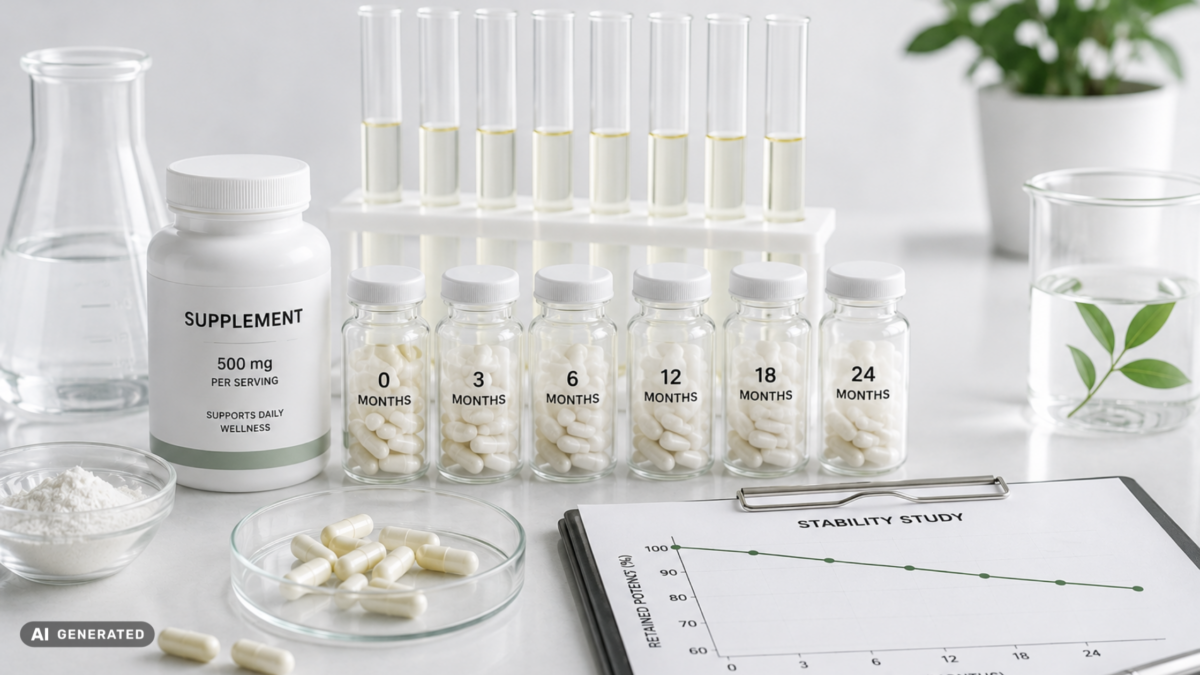
Food Supplements Europe gives an example schedule for a three-year product involving initial testing followed by analyses at 1, 3, 6, 12, 18, 24 and 36 months, while emphasising that the schedule should reflect the intended shelf life.
This is an industry example, not a mandatory schedule for every supplement.
The correct frequency should be justified for the product.
Packaging Is Part of the Stability Study
Testing the formulation without its final packaging can miss one of the biggest drivers of stability.
Packaging controls exposure to:
- oxygen
- water vapour
- UV and visible light
- temperature fluctuations
- repeated opening
- external contamination
Food Supplements Europe specifically identifies packaging protection and integrity as a core objective of supplement stability testing and notes that the same formulation may be more stable in one package than another.
A vitamin powder in an aluminium laminate sachet may behave differently from the same powder in a large plastic tub repeatedly opened by the consumer.
A softgel bottle with a strong moisture barrier may perform differently from a refill pouch.
The formula has not changed.
The exposure conditions have.
That means a packaging change can also create a stability question.
“In Use” Stability Can Matter Too
The unopened product is not always the full story.
Liquids, powders, gummies and large multi-dose packs may remain open for weeks or months after first use.
Every opening can introduce:
- oxygen
- humidity
- temperature changes
- microbial contamination
- repeated physical handling
Food Supplements Europe recommends considering in-use studies for relevant products and simulating the gradual removal of product from the pack during the expected consumption period.
A product can therefore have two stability questions:
Does it survive unopened storage?
and
Does it remain acceptable after the consumer opens it?
Multivitamins Are Harder Than Single-Ingredient Products
A product containing one relatively stable mineral creates a different analytical problem from a multivitamin with ten or fifteen active ingredients.
In multi-ingredient products, each substance can have its own degradation profile.
Food Supplements Europe therefore warns that reliance on one marker ingredient may be insufficient and that several assays may be required where different ingredients degrade differently.
This creates a practical formulation problem.
The product’s shelf life may ultimately be limited by its least stable critical component.
Eleven ingredients could remain comfortably within specification.
If the twelfth falls below the declared amount, the label can still become problematic.
The strongest ingredient does not determine shelf life.
The weakest critical one often does.
Different Dosage Forms Create Different Risks
Tablets
Potential stability questions can include potency, hardness, friability, disintegration and moisture uptake.
Capsules
Shell integrity, moisture exchange, active-content stability and disintegration can become relevant.
Softgels
Oxidation, shell integrity and interaction between fill material and capsule shell may matter.
Powders
Moisture uptake, caking, solubility and oxidation can affect product performance.
Liquids
pH, viscosity, microbiological quality, separation and oxidation may all become relevant.
Food Supplements Europe consequently recommends different physical and analytical parameters according to dosage form rather than applying one generic test panel.
A stability study should follow the product.
Not the template.
Why “500 mg at Manufacture” Is Not Enough
Suppose a supplement is labelled:
500 mg per daily dose
The manufacturer analyses the first production batch.
Result:
503 mg
Excellent.
But that result does not answer:
- What remains after 6 months?
- What remains after 12 months?
- What remains after 24 months?
- Does the packaging protect the ingredient?
- Does another component accelerate degradation?
- Is the value still within the relevant tolerance?
- Does the product still satisfy any claim linked to that quantity?
The production result demonstrates manufacturing accuracy.
It does not demonstrate shelf-life stability.
The product does not stop changing once the batch is released.
What a Practical Supplement Stability Programme Should Include
There is no reason to test every imaginable parameter at every timepoint.
A better approach is to define critical attributes before the study begins.
For many products, that means considering:
- Declared active ingredients
Particularly stability-sensitive nutrients and substances relevant to claims. - Physical properties
Appearance, colour, odour, texture, hardness, dissolution or other dosage-form-specific characteristics. - Microbiology where relevant
Especially liquids, emulsions and other higher-moisture formulations. Food Supplements Europe recommends microbiological monitoring where the formulation presents an appropriate risk. - Final packaging
The commercially intended container, closure and barrier system should be represented. - Realistic storage conditions
Conditions should reflect the markets in which the product will actually be sold. - Multiple timepoints
Enough data to identify trends rather than just isolated pass/fail values. - Accelerated data where useful
Particularly during development or before sufficient real-time data exist. - Real-time confirmation
To verify that the commercial shelf-life prediction remains justified.
The study should answer a business question.
Not simply generate laboratory reports.
Common Stability Mistakes
Setting Shelf Life Because Similar Products Use 24 Months
A competitor’s shelf life is not stability data for your formulation.
Different suppliers, packaging, nutrient forms and matrices can change degradation rates.
Using Raw-Material Stability Data as Finished-Product Evidence
An ingredient may be stable in the supplier’s container and less stable after mixing it with ten other ingredients.
Testing Only at Time Zero
This verifies initial composition.
It does not verify shelf life.
Using Accelerated Data as the Only Long-Term Evidence
Accelerated studies are valuable predictive tools, but industry GMP guidance recommends accompanying them with real-time data and other evidence where possible.
Adding Large Overages Without Supporting Data
More active ingredient is not automatically safer from a compliance perspective.
Overages should reflect expected losses while remaining compatible with tolerances, safety considerations and applicable market limits.
Changing Packaging Without Reconsidering Stability
Packaging is part of the product’s protection system.
A new jar, pouch, closure or blister can change exposure to oxygen, moisture and light.
How Makrolife Biotech Can Support Supplement Stability Testing
Makrolife Biotech provides shelf-life and stability studies for foods, animal feed and dietary supplements, alongside quantitative analysis of supplement ingredients and nutrients. Its current testing portfolio includes shelf-life determination as well as vitamin, mineral, ingredient and product-specific analyses.
Depending on the formulation, a stability programme can combine:
- initial active-ingredient quantification
- accelerated storage
- real-time storage
- defined analytical timepoints
- vitamin and mineral assays
- microbiological testing
- physical and organoleptic assessment
- packaging-related evaluation
- finished-product verification
- review of label values against analytical results
The objective is not simply to assign a date to the package.
It is to generate evidence that the product can support that date.
Shelf Life Is a Product Claim Too
Supplement brands spend considerable effort substantiating what appears on the front of the label.
The back of the label deserves the same attention.
A declared nutrient amount and a best-before date are linked.
If the product promises 500 mg and a 24-month shelf life, the stability programme needs to demonstrate that those two statements remain compatible.
That is why stability should be considered before commercial launch, not after the first batch has already spent a year in the warehouse.
Formulate for the label.
Test the finished product.
Understand the degradation curve.
Confirm it in real time.
Because the number that matters is not only what went into the product.
It is what is still there when the consumer takes the last dose.
Sources
- European Commission, Guidance Document for Competent Authorities for the Control of Compliance with EU Legislation with Regard to the Setting of Tolerances for Nutrient Values Declared on a Label. The Commission notes that the document has no formal legal status but continues to publish it as its guidance on nutrient tolerances.
- European Parliament and Council, Directive 2002/46/EC on food supplements.
- European Parliament and Council, Regulation (EC) No 1924/2006 on nutrition and health claims made on foods.
- European Commission, Food Supplements.
- Food Supplements Europe, Guide to Good Manufacturing Practice for Manufacturers of Food Supplements, 2026.
- Abdelfatah et al., A stability-indicating HPLC assay of ten different vitamins in a food supplement, Talanta, 2024.
- Makrolife Biotech, Food & Supplements and Stability & Shelf-Life Testing.